

Protect Restaurant Drains With Our Garbage Grinder Alternative
Restaurant drain problems often start long before food reaches the sink. Best practices help your entire team reduce the amount of food waste entering the plumbing system and create multiple lines of defense before food solids become a bigger problem.
- Servers and bussers can help by scraping plates before they reach the dishroom.
- Prep employees should keep food scraps, trimmings, rice, pasta, and other solids out of prep sinks.
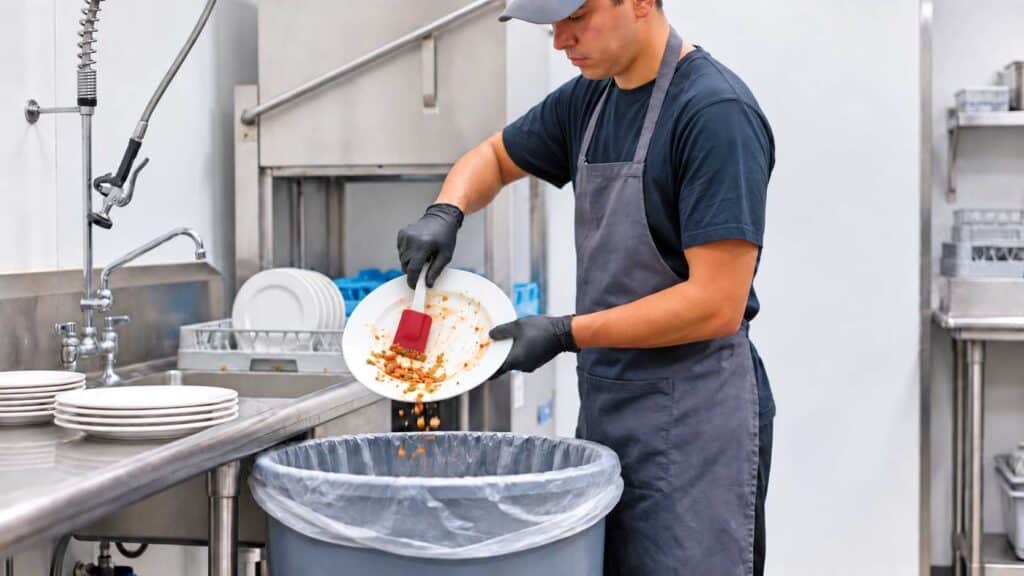
- Dishroom employees should follow a simple process: scrape first, pre-rinse second, and wash third.
- Three-compartment sinks should not be used as food disposal stations.
- Food debris should be removed from floors before it is washed toward floor drains.
- The Drain Strainer is a garbage grinder alternative that captures food solids from the sink.
- Managers should make drain protection part of employee training and reinforce these best practices over time.
- Small, consistent habits throughout the kitchen can help reduce slow drains, clogs, odors, drain flies, grease trap issues, and plumbing disruptions.
Let’s take a closer look at each of these main points in more detail.
Restaurant Drain Problems Start Long Before the Sink
If your restaurant has slow drains, recurring clogs, grease trap problems, or a plumbing backup, it’s easy to focus on what is happening at the drain. But in reality, many of these problems begin much earlier.
Food solids can start their journey toward your plumbing at the dining table, server station, prep area, dishroom, or three-compartment sink.
Best practices to keep food out of your plumbing should focus on stopping food waste at every opportunity before it has a chance to enter your restaurant drain system.
Restaurant Drain Protection Is a Team Responsibility
Keeping food solids out of your plumbing should not be viewed as solely the dishwasher’s responsibility. Servers, bussers, prep cooks, line cooks, dishroom employees, and managers all influence how much food waste eventually reaches the drains.
When everyone understands their role, your restaurant can create multiple opportunities to remove food solids before they become a plumbing problem.
Scrape Plates at the Server Station
Servers and bussers are the first line of defense. Plates returning from the dining room often contain leftover food, garnishes, lemon wedges, bones, napkins, straws, and other debris.
Whenever possible, this material should be scraped into a trash or food-waste container before plates are stacked and sent into the dishroom.
The less food that arrives on the plates, the less food dishroom employees have to manage later and the better the plates can stack with toppling over.
Make Proper Scraping Easier During Busy Shifts
Best practices have to work even when your restaurant is busy. If trash containers or scraping stations are inconveniently located, employees are more likely to send plates covered with food directly into the dishroom.
Placing waste containers where employees actually need them makes proper scraping part of the normal workflow rather than an extra step that gets skipped during busy lunch and dinner rushes.
Keep Prep Waste Out of Kitchen Sinks
Food solids don’t only come from dirty plates. Prep areas can send a surprising amount of food debris down your plumbing.
Vegetable trimmings, meat scraps, rice, pasta, breading, seeds, peels, and other ingredients can easily be rinsed into a sink when employees are working quickly.
Prep sinks should not become food disposal systems simply because there’s a drain nearby.
Give Prep Employees a Better Place for Food Waste
Employees are more likely to follow a drain-protection procedure when the alternative is convenient. Keeping appropriate trash or food-waste containers near prep areas makes it easier to scrape containers, cutting boards, pans, and utensils before they are rinsed.
Removing food solids before washing may seem like a small step, but repeated across hundreds of prep tasks and shifts, it can significantly reduce the amount of food debris entering your plumbing system.
Scrape First, Spray Second, Wash Third
The dishroom is where large quantities of food debris can converge at once, which makes a consistent process especially important. A simple rule is to scrape first, spray second, and wash third.
Employees should remove as much solid material as practical before reaching for the pre-rinse sprayer. Spraying a plate covered with food may quickly clean the plate, but it transfers that food directly into the sink and toward the drain.
Train Dishroom Employees on Why the Process Matters
It is easier for employees to follow best practices when they understand the reasons behind it. Dishroom employees may see only a few pieces of food going toward the drain at a time and assume they are insignificant.
The problem is repetition. Small amounts of food waste can become a much larger plumbing load when the process is repeated shift after shift.
Don’t Turn the Three-Compartment Sink Into a Food Disposal Station
Three-compartment sinks are another place where large amounts of food solids can enter commercial kitchen plumbing. Employees may be tempted to dump pans, storage containers, sauces, soups, rice, pasta, or leftover ingredients into the sink before washing the container.
Whenever possible, solid material should be removed first rather than relying on the drain to carry it away.
Be Careful With Foods That Don’t Look Like a Drain Problem
Some food waste appears harmless because it is small, soft, or mixed with liquid. Rice, pasta, coffee grounds, vegetable pieces, sauces containing food particles, and other materials may wash down easily at first.
That does not mean they disappear once they enter the plumbing. Keeping as much of this material as possible out of the drain reduces the amount of solids that can accumulate farther downstream.
Don’t Forget About Your Floor Drains
Sink drains are not the only part of the plumbing system affected by kitchen procedures. Food particles can also reach floor drains during sweeping, mopping, and end-of-shift cleanup.
Spraying or washing food debris across the floor and toward a drain may seem efficient, but it simply moves the waste into another part of the plumbing system.
Remove Floor Debris Before Washing It Away
Whenever practical, solid debris should be swept, collected, and disposed of before floors are washed. Allowing food waste to repeatedly enter floor drains can contribute to buildup, unpleasant odors, slow drainage, and the organic material that helps support drain fly activity.
What looks like a shortcut during cleanup can eventually create a much bigger sanitation or maintenance problem.
Use the Drain Strainer as A Garbage Grinder Alternative
Even a well-trained kitchen staff will never keep every food particle out of the sink. Restaurants move fast, employees get busy, and food debris inevitably gets missed.
The Drain Strainer is an effective and affordable garbage grinder alternative. Invented by a former restaurant owner, it captures food solids while still allowing your sinks to drain quickly.
Stop Food Solids Before They Become Grease Trap Problems
Keeping food solids out of your restaurant drains also helps reduce grease trap clogs. Your grease trap already has an important job managing fats, oils, and grease.
Sending food debris downstream adds to the material that needs to be collected, maintained, and eventually removed.
Stopping solids before they enter the grease trap helps your entire waste-management system work more effectively.
Make Drain Protection Part of New Employee Training
Even the best restaurants experience employee turnover, which means your best practices can fade away over time if they are not reinforced.
Drain protection should be covered when new servers, bussers, prep employees, cooks, and dishroom workers are trained.
A few minutes spent explaining where food waste should go and why it matters helps establish better habits from the beginning.
Managers Need to Reinforce These Best Practices
Management also plays an important role in making these procedures stick. If employees routinely see managers allowing food to be washed down sinks or sprayed toward floor drains, these best practices won’t mean as much.
Managers should periodically observe how food waste is actually being handled and make sure employees have convenient access to the scrapers, trash cans, strainers, and equipment that are needed to follow this process.
Protect Restaurant Drains With Our Garbage Grinder Alternative
If you want to keep your three bay sinks from getting clogged with food solids, The Drain Strainer™ solid separator captures food debris that either can be disposed of or kept for composting.
The Drain Strainer™ helps you avoid issues with what gets put down your restaurant floor drains. No matter how much you focus on employee training, short cuts are always going to be taken and items are going to be put down your garbage grinder that can harm it.
If a utensil accidentally goes down The Drain Strainer™, it simply ends up in your strainer drawer and can be easily retrieved without any damage.
The Drain Strainer garbage grinder alternative helps commercial kitchens capture food solids while still allowing their sinks to drain quickly.
By combining better employee procedures with a solids-separation system designed for the demands of a busy commercial kitchen, operators can help protect their drains, grease-management equipment, and day-to-day workflow.
Good drain protection requires building a system of best practices that makes keeping food solids out of your plumbing part of the way your kitchen operates every day.
To avoid issues with clogged grease traps or garbage grinders that are leaking or have burned out motors, The Drain Strainer™ solids separator is an effective and affordable commercial kitchen waste disposal system alternative that doesn’t require the use of water or electricity.
Invented by a former restaurant owner, The Drain Strainer™ can eliminate issues with mangled silverware or dangers from employees putting their hands down the commercial waste disposal unit trying to clear out a clog.
Click here to find out more about how our garbage grinder alternative can keep your grease trap free from clogs.
Let The Drain Strainer™ keep your three bay sinks running smoothly by capturing food solids and avoiding any problems with your restaurant floor drains.