

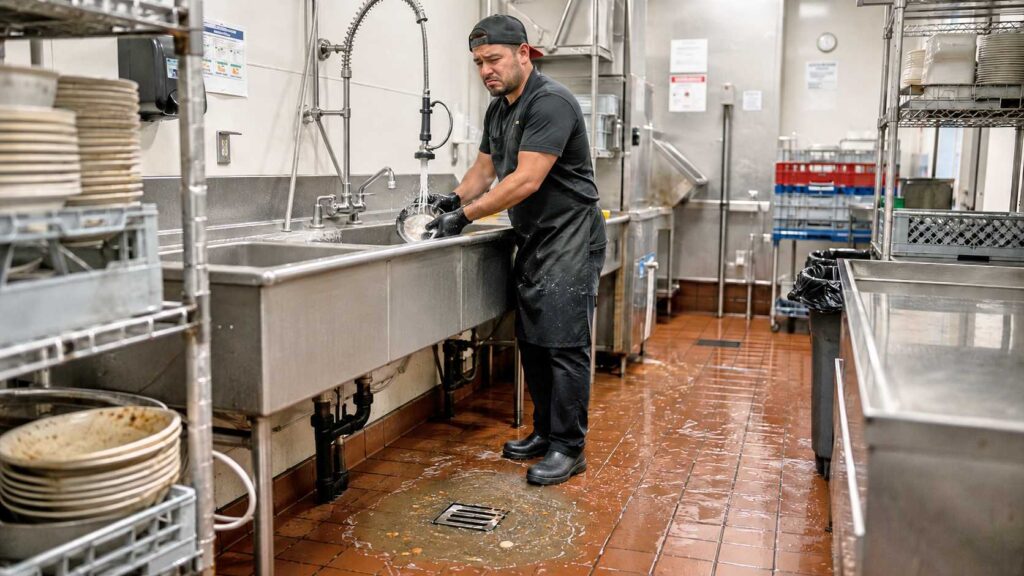
Protect Commercial Kitchen Floor Drains With Our Solid Separator
Many backups in commercial kitchen floor drains might actually be a result of problems that started much farther upstream. Food solids washed down dish sinks, prep sinks, bar sinks, and garbage disposals can travel through your plumbing system, combine with grease, and eventually create a blockage that shows up at the floor drain.
- Floor drains are often where a plumbing problem becomes visible, not where the problem actually started.
- Food solids washed down sinks can settle in shared drain lines, especially around bends, fittings, and areas where flow slows down.
- Grease and starches can make the problem worse by helping food debris stick together and form thick buildup inside the pipes.
- Dish rooms, prep sinks, and bar sinks can all contribute to downstream clogs when food scraps are regularly rinsed into the plumbing system.
- Commercial garbage disposals do not make food waste disappear; they simply grind it into smaller pieces that still have to travel through the drains and grease trap.
- Repeatedly clearing the same floor drain may restore flow temporarily, but the problem can return if the kitchen keeps sending the same solids downstream.
- The best long-term strategy is to stop food solids at the source with better scraping habits and equipment like The Drain Strainer, which captures food debris before it can reach floor drains, wall drains, and grease traps.
Let’s take a closer look at each of these main points in more detail.
Your Floor Drains May Not Be the Real Problem
Few things disrupt your operation faster than water backing up through commercial kitchen floor drains. Employees are trying to keep wastewater away from work areas, the dish room is slowing down, and someone is making an emergency call to a plumber.
When water is coming out of your commercial kitchen floor drains, it’s natural to assume that those floor drains are the source of the problem. But that’s not always the case.
In many commercial kitchens, the floor drain is simply where a larger plumbing problem finally becomes visible. The clog may have been developing farther upstream for weeks or months as food scraps, grease, starches, and other debris were repeatedly washed down kitchen sinks.
Having a plumber clear your commercial kitchen floor drains gets the water moving again. But unless you figure out what caused the blockage in the first place, you’ll be dealing with the same problems again in the future.
Follow the Plumbing Problems Further Upstream
Commercial kitchen plumbing is a connected system. Your 3-compartment sinks, prep sinks, dishwashing areas, bar sinks, floor drains, and other fixtures eventually connect to common branch lines or larger waste lines before wastewater leaves the building.
That means something washed down one sink can travel quite a distance before it causes trouble.
Food debris may move easily through the first few feet of plumbing. It can then reach a bend, fitting, low spot, or section of pipe where the flow slows down. Some of that material settles instead of continuing through the plumbing system.
Over time, more debris gets caught in the same area. Eventually, the restriction becomes large enough that the drain line can no longer handle the amount of wastewater your kitchen produces.
The backup might then appear through commercial kitchen floor drains that are located many feet away from the sinks where the food waste originally entered the plumbing.
Food Solids Don’t Disappear When They Go Down the Sink
During a busy shift, it’s easy to lose sight of what actually happens to food debris after it goes down a drain. A few pieces of rice, vegetable scraps, breading, or bits of food disappear from sight, and everyone moves on to their next task.
But those food solids have not disappeared. They are simply somewhere else in your plumbing system.
A small amount of food debris may not create an immediate problem. The trouble comes from what happens day after day.
A busy commercial kitchen with small amounts of food waste going down the drains from every shift can eventually add up to a significant amount of material moving through your drains.
Rice, pasta, meat scraps, vegetable pieces, coffee grounds, breading, sauces, and leftover food particles can all become part of the problem.
The issue is rarely one big mistake. More often, it is the cumulative effective of small amounts of food waste continually making their way into a system that was never intended to become a food waste pipeline.
Grease Gives Food Solids Something to Stick To
Food debris becomes even more troublesome when fats, oils, and grease are present.
FOG can coat the interior of commercial drain lines. As that layer develops, food particles traveling through the pipe have something to stick to. Once a few solids become trapped, they can begin catching additional material.
The result can be a steadily growing restriction made up of grease, food particles, soap residue, and other debris.
This is why commercial kitchen floor drains can appear to work normally for months and then suddenly start causing problems. The blockage doesn’t usually happen all at one.
It may have been slowly developing until the remaining opening in the pipe became too small to accommodate wastewater during a busy period.
Keeping grease out of your plumbing is important, but so is reducing the amount of food solids that have an opportunity to combine with it.
Starches Create Their Own Drain Problems
Some of the foods commonly served in commercial kitchens are particularly difficult on your plumbing system.
Rice, pasta, potatoes, flour, breading, and other starch-heavy foods become sticky when mixed with water. Some can swell, while others break down into a paste-like residue.
Combine that starch with grease and other food particles, and you create a thick sludge that does not travel through drain lines as easily as water does.
Restaurants serving large quantities of pasta, rice, fried foods, baked goods, or other starch-heavy menu items should pay especially close attention to what employees are washing down their sinks.
Even if the food particles look small, the cumulative effect can become a much bigger plumbing problem.
Why Commercial Kitchen Floor Drains Often Take the Blame
When a shared drain line becomes restricted, wastewater needs somewhere to go.
Commercial kitchen floor drains are frequently the lowest openings connected to that portion of your plumbing system. As pressure builds behind a restriction, wastewater may begin coming up through the floor drain.
That makes your commercial kitchen floor drains look guilty.
One clue that the real problem is farther upstream is when the floor drain reacts to something happening elsewhere in the kitchen.
You may notice the floor drain gurgling when a sink is emptied. Water may rise from it when the dish machine drains.
The problems may only appear during the busiest part of the day, when multiple fixtures are sending large volumes of wastewater into the drainage system at once.
Those are all signs that you may be dealing with a restriction in a shared drain line rather than a simple problem with the floor drain itself.
Your Dish Room Might Be Real Culprit
Few areas of your commercial kitchen send more food residue toward the plumbing system than the dish room.
During the dinner rush, employees are moving quickly. Plates, pans, bowls, utensils, and food containers arrive continuously.
Ideally, these dishes are all thoroughly scraped before rinsing, but anyone who has operated a busy restaurant knows that reality does not always match the training manual.
Food scraps get rinsed into sinks. Sauces and starches get washed from pans. Small pieces of food disappear through sink baskets.
Employees may assume that if the water is still flowing, then everything is fine.
The large amount of water used in a dish room can actually make the problem less obvious. Food solids are carried away quickly enough that staff members don’t see what’s happening farther down the line.
Eventually all those food solids turn into an actual plumbing problem. That problem could show up as a slow drain, an overloaded grease trap, or wastewater coming through a floor drain across the room.
Prep Sinks Also Quietly Add to the Problem
The dish room is not the only place commercial kitchen owners should be keeping an eye on.
Prep sinks can send a surprising amount of food debris into the plumbing system over the course of a day.
Vegetable trimmings, pieces of meat, flour, sauces, rice, potato residue, and other scraps can easily get rinsed down a drain during food preparation and cleanup.
Individually, these amounts may seem insignificant.
But if you have several prep stations contributing small amounts of debris during every shift, your total food solids load can be substantial.
This is why solving recurring drain problems requires looking at your entire kitchen instead of focusing exclusively on the area where the backup appeared.
Don’t Forget About Your Bar Sinks
Restaurants with full-service bars have another potential source of solids entering the drain system.
Fruit pulp, citrus pieces, garnishes, straws, napkin fragments, and other debris can find their way into bar sinks. Sugary drink residue can also create sticky conditions inside drain lines that make it easier for additional material to accumulate.
Depending on how your plumbing is configured, some of that wastewater may eventually enter lines connected to other parts of the facility.
Once again, the place where the clog finally becomes noticeable may not be the place where the material that actually caused the problems entered your plumbing.
A Commercial Garbage Disposal Does Not Make Food Waste Disappear
Commercial garbage disposals can create another misconception about food waste.
A disposal does not eliminate food solids. It grinds them into smaller pieces and sends those pieces into your wastewater system.
Those smaller particles still have to travel through your drain lines.
They can still encounter grease. They can still settle. They can still reach your grease trap or grease interceptor.
Grinding food into smaller pieces may make it easier to get the waste out of the sink, but it does not remove that material from your plumbing system.
That’s one reason why so many commercial kitchens are looking for alternatives to traditional commercial garbage disposals.
Instead of grinding up food waster and sending it downstream, removing food solids from the wastewater before they enter the drain system addresses the problem much closer to its source.
Your Grease Trap Doesn’t Need Extra Food Solids Either
Your grease trap or grease interceptor has an important job to do. It is designed to help separate fats, oils, and grease from wastewater before those materials travel farther into the sewer system.
Food solids make that job more difficult.
When excessive food solids reach your grease trap, they can settle at the bottom and consume valuable capacity. That can contribute to odors, buildup, reduced performance, and potentially more frequent cleanout services.
The same food scraps that contribute to restrictions in your drain lines create similar problems once they reach the grease trap.
A better approach is to keep as much unnecessary food waste as possible from getting into your grease trap.
Clearing the Clog Is A Temporary Solution
When wastewater is backing up onto the kitchen floor, getting the line open again is an immediate priority.
A qualified commercial plumber needs to snake, cable, hydro jet, or otherwise clean out the affected drain line. Professional drain cleaning is an important part of maintaining a busy commercial kitchen, and sometimes there is simply no substitute for it.
But clearing the blockage only addresses what has already accumulated.
If your kitchen goes right back to rinsing food solids into your same drain system, the rebuilding process starts all over again.
This gets commercial kitchen operators trapped in a frustrating cycle. The drain backs up. A plumber clears it. Everything works for a while. Then the same drain backs up again.
At some point, it makes more sense to stop and ask a different question: What keeps getting into this drain line that requires it to need it cleaned?
Stop Food Solids Where the Problem Starts
The best place to deal with food solids is before they enter your commercial plumbing system.
Thoroughly scraping plates, pans, and cookware before washing is an important first step. Employees need to understand that your sinks are not waste receptacles and that food scraps do not simply disappear because they fit through a drain opening.
But busy kitchens also benefit from equipment that makes proper solids management easier for employees.
That is where a commercial food solids separator can make a significant difference.
Instead of relying on employees to catch every individual scrap or sending food through a commercial garbage disposal, you can create a physical barrier between food solids and your drain system.
The Drain Strainer Helps Stop the Problem at the Source
The Drain Strainer helps commercial kitchens keep food solids out of their plumbing systems while allowing their sinks to drain quickly.
Wastewater from your sinks passes through our system while food debris is captured in a removable stainless steel strainer drawer. Employees simply remove the drawer and empty the collected food waste into the trash or save appropriate material for composting.
The important difference is where that food waste ends up.
Instead of traveling through your drain lines, settling in your grease trap or eventually helping create a floor drain backup, those solids are removed from the wastewater system altogether.
The Drain Strainer is also an effective and affordable alternative to a commercial garbage disposal. Instead of grinding food into smaller pieces and sending it farther downstream, you capture those solids while they are still easy to manage.
Better Commercial Floor Drains Require Better Kitchen Habits
Equipment is only part of the solution. Employee habits matter too.
Your dish crew and kitchen staff should understand why food needs to stay out of your plumbing system. When employees see scraping dishes as just a suggestion, compliance can disappear during a busy shift.
It helps to explain the bigger picture.
The food they wash down a sink today contributes to the floor drain backup that shuts down their dish area next month. Keeping solids out of the drains helps prevent foul odors, grease trap problems, slow drainage, emergency plumbing calls, and wastewater on the kitchen floor.
When employees understand the reason behind the procedure, good habits are much easier to reinforce.
Pay Attention to the Warning Signs
Major drain backups don’t happen without some warning.
A sink that takes a little longer to empty, a floor drain that occasionally gurgles, an unusual plumbing odor, or water moving in one drain when another fixture is emptied all indicate that a restriction is developing.
These signs are easy to ignore while the kitchen is still functioning, but addressing a developing drainage issue during normal operating hours is much easier than dealing with wastewater backing onto the floor in the middle of your busiest Friday night.
If the same area has been cleared repeatedly, it is especially important to investigate why the restriction keeps returning.
Know When to Bring in a Commercial Plumber
Not every commercial drain problem should be handled by your kitchen staff.
If several fixtures are draining slowly, wastewater is coming through a floor drain, or the same backup keeps returning, an experience commercial plumber can help determine where the restriction is located and whether there are larger problems with the drainage system.
When they show up, give the plumber as much information as possible. Explain what was happening when the backup occurred. Did someone just empty the 3-compartment sink? Did the dish machine drain? Were several sinks being used simultaneously?
Those details can help the plumber trace the affected line and understand how different fixtures are interacting.
Once the line is cleared, you can then focus on preventing food solids from getting back into your plumbing system.
Repeated Drain Backups Cost More Than Just the Plumbing Bills
The cost of clogged commercial kitchen drains goes well beyond the invoices from the plumber.
Employees may be unable to use sinks or dishwashing equipment while the problem is being repaired. Wastewater on the floor creates slip hazards and sanitation concerns.
Managers have to pull their attention away from customers and normal operations to deal with the emergency.
In more serious situations, part of the kitchen may have to stop operating entirely until the problem is resolved.
Those disruptions are particularly expensive when they happen during a busy lunch and dinner rushes.
Preventive maintenance is almost always easier to manage than an emergency. Reducing the amount of food solids entering your plumbing system is one of the simplest ways to reduce your risk.
Protect Commercial Kitchen Floor Drains With Our Solid Separator
If you want to keep your three bay sinks from getting clogged with food solids, The Drain Strainer™ solid separator captures food debris that either can be disposed of or kept for composting.
The Drain Strainer™ helps you avoid issues with what gets put down your commercial kitchen floor drains. No matter how much you focus on employee training, short cuts are always going to be taken and items are going to be put down your commercial disposal unit that can harm it.
If a utensil accidentally goes down The Drain Strainer™, it simply ends up in your strainer drawer and can be easily retrieved without any damage.
Clogged commercial kitchen floor drains might initially look like a floor drain problem, but appearances can be misleading.
The food debris responsible for the restriction may have entered the plumbing through a dish sink, prep sink, bar sink, or commercial garbage disposal many feet away. Over time, those solids can combine with grease, settle in drain lines, consume grease trap capacity, and eventually create a blockage.
The commercial kitchen floor drains are simply where your kitchen finally sees the consequences.
Clearing that blockage is important. Preventing the next one should be the long term goal.
If your commercial kitchen regularly sends food solids into its wastewater system, consider what you can change upstream. Better scraping procedures, stronger employee training, and a food solids separator like The Drain Strainer can help keep those materials out of your floor drains, wall drains, and grease traps.
Instead of repeatedly dealing with the problem after it travels through your plumbing system, stop it where it starts.
To avoid issues with clogged grease traps or foodservice disposers that are leaking or have burned out motors, The Drain Strainer™ solids separator is an effective and affordable commercial kitchen waste disposal system alternative that doesn’t require the use of water or electricity.
Invented by a former restaurant owner, The Drain Strainer™ can eliminate issues with mangled silverware or dangers from employees putting their hands down the commercial waste disposal unit trying to clear out a clog.
Click here to find out more about how our foodservice disposer alternative can keep your grease trap free from clogs.
Let The Drain Strainer™ keep your three bay sinks running smoothly by capturing food solids and avoiding any problems with your commercial kitchen floor drains.