

Why Is Drain Prevention Better Than Restaurant Drain Cleaning?
Restaurant drain cleaning and drain prevention serve two different purposes. While drain cleaning removes existing blockages and buildup, drain prevention and protection focuses on stopping food solids, grease, and other debris from causing plumbing problems in the first place. For restaurant owners, understanding this difference can help reduce maintenance expenses, prevent unexpected disruptions, and keep their kitchen operations running smoothly.
- Drain cleaning addresses existing problems. Professional plumbers use methods such as drain snaking and hydro jetting to clear blockages, but these services don’t necessarily prevent future clogs.
- Food solids are a major contributor to commercial kitchen drain problems. Rice, pasta, vegetables, and other food scraps can accumulate in drain lines and grease traps, even when commercial garbage disposals grind them into smaller particles.
- Drain prevention focuses on stopping problems at their source. Proper food disposal, employee training, grease management, and food solids separation help keep unnecessary waste out of commercial plumbing systems.
- The Drain Strainer™ helps prevent clogged drains. By capturing food solids beneath commercial sinks before they enter downstream plumbing, The Drain Strainer offers a practical alternative to traditional commercial garbage disposals.
- Preventing food solids from entering grease traps can reduce maintenance needs. Separating food debris from wastewater helps minimize sludge accumulation and may reduce the frequency of grease trap pumping.
- Drain prevention can help restaurants avoid costly disruptions. Fewer preventable blockages mean fewer emergency plumbing calls, less employee downtime, and more reliable kitchen operations.
- Drain cleaning and drain prevention work together. Routine plumbing maintenance is still important, but investing in preventive solutions like The Drain Strainer can help reduce recurring problems and their associated expenses.
Let’s take a closer look at each of these main points in more detail.
What’s the Difference Between Restaurant Drain Cleaning and Drain Prevention?
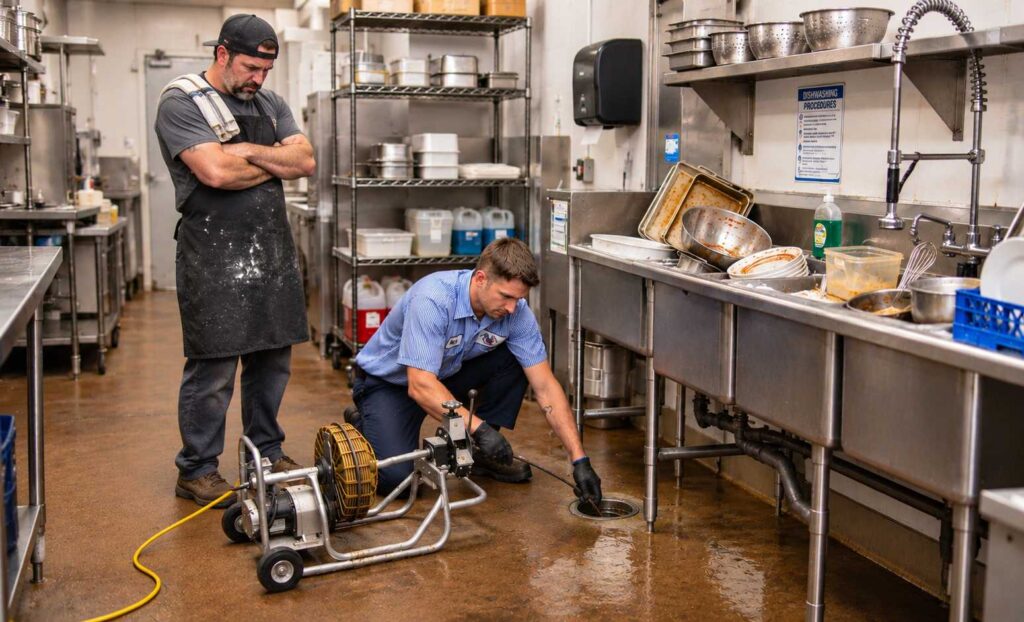
A clogged restaurant drain is one of those problems that can bring a busy kitchen to a standstill. One minute, employees are washing dishes and keeping up with the dinner rush.
The next, wastewater is backing up into the three-compartment sink or overflowing onto the kitchen floor.
The restaurant manager calls a plumber, the blockage gets cleared, and everything eventually returns to normal. Problem solved, right?
Not necessarily.
While restaurant drain cleaning is sometimes necessary, it doesn’t usually address the underlying cause of the blockage.
If the same food scraps, grease, and debris continue entering your plumbing system, there’s a good chance you’ll be dealing with another clog in the future.
That’s where drain prevention and protection comes into the picture.
Understanding the difference between restaurant drain cleaning and drain prevention can help restaurant owners reduce plumbing expenses, avoid unexpected disruptions, and keep their commercial kitchens operating more efficiently.
What Is Drain Cleaning and How Does It Work?
Restaurant drain cleaning is the process of removing accumulated debris, grease, and other obstructions from plumbing lines to restore proper drainage.
In commercial kitchens, professional plumbers use several methods to clear blocked drains.
Mechanical drain snakes and augers can break through obstructions, while hydro jetting uses high-pressure water to remove accumulated grease and other materials from the inside of pipes.
Some restaurants also turn to chemical drain cleaners, although these products can create safety concerns, damage certain plumbing components, or simply move a grease-related problem farther downstream.
They should never be considered a substitute for proper commercial kitchen waste management.
Grease trap cleaning is another important part of commercial kitchen plumbing maintenance. Regular pumping removes accumulated fats, oils, grease, and food solids before they interfere with the grease trap’s operation.
These cleaning methods serve an important purpose. When a drain is clogged, getting wastewater flowing again is the immediate priority.
However, there’s an important distinction between removing an existing blockage and preventing another one.
Restaurant drain cleaning removes the materials causing a problem. Drain prevention and protection helps keep those materials from creating the problem in the first place.
And for restaurant owners who seem to have their plumber’s phone number memorized, that difference can be significant.
Why Do Restaurant Drains Keep Getting Clogged?
Commercial kitchens generate enormous amounts of food waste throughout a typical day. Every plate, pot, pan, and cooking utensil that makes its way into the dishroom potentially brings additional food scraps and grease into the washing process.
Even when employees scrape dishes before washing them, smaller particles often remain. Rice, pasta, vegetables, meat scraps, and other food debris can easily get rinsed down the sink.
Once those materials enter the plumbing system, they can accumulate inside drain lines, floor drains, and grease traps. Grease can make matters worse by sticking to the inside of pipes and trapping additional debris.
Over time, these accumulations restrict wastewater flow and increase the likelihood of a blockage.
Commercial garbage disposals can add another complication. Although disposals grind food waste into smaller pieces, they don’t actually eliminate it.
Those smaller particles still travel through the plumbing system, potentially contributing to the same problems farther downstream.
This raises an important question.
If your restaurant keeps paying someone to remove food waste from your plumbing system, wouldn’t it make more sense to prevent that waste from entering the pipes?
That’s the fundamental idea behind restaurant drain prevention.
What Is Restaurant Drain Prevention?
Restaurant drain prevention and protection focuses on reducing the materials that enter a plumbing system and cause future blockages.
Rather than waiting for a drain to clog, restaurant owners take proactive measures to manage food waste, grease, and other debris before they become expensive plumbing problems.
Some preventive measures are relatively simple. Employees should scrape leftover food into the trash before washing dishes, properly dispose of fats, oils, and grease, and avoid rinsing unnecessary waste down the sink.
Training employees to follow these procedures consistently is an important part of an effective prevention strategy.
However, even the best-trained employees can’t reasonably be expected to remove every grain of rice, strand of pasta, or vegetable fragment before washing dishes. During a busy shift, food scraps will inevitably make their way into the sink.
That’s why effective drain prevention and protection should include more than employee training.
Installing a commercial food solids separator, such as The Drain Strainer™, adds another layer of protection by capturing food debris before it enters downstream plumbing.
Instead of depending entirely on employees to keep food scraps out of the drains, a solids separation system helps manage the waste that makes it past normal scraping and rinsing procedures.
Effective Restaurant Drain Prevention Starts at the Sink
When restaurant owners experience recurring drain problems, they often focus on the location where the blockage occurs.
Perhaps the floor drain keeps backing up. Maybe the grease trap requires frequent cleaning, or a wall drain repeatedly becomes obstructed.
While those are the places where the problems become visible, the source of the trouble may be several feet away at the three-compartment sink.
That’s where much of the food waste enters the plumbing system.
The Drain Strainer was designed to address this problem at its source.
Our stainless steel food solids separator installs beneath commercial sinks and uses a removable strainer drawer to capture food particles while allowing wastewater to continue flowing through the system.
Instead of grinding food waste into smaller particles and sending it down the drain, The Drain Strainer physically separates those solids from the wastewater.
Employees simply remove the drawer, empty the collected food scraps into an appropriate waste container, and return the drawer to its position.
Unlike traditional commercial garbage disposals, The Drain Strainer doesn’t require electricity or a motor to operate. There are no grinding blades, and there isn’t a complicated mechanical system to maintain.
It’s a straightforward approach to a common commercial kitchen problem: Keep the water flowing while keeping the food waste out of the pipes.
And because the food solids are captured before they reach downstream plumbing, The Drain Strainer helps protect more than just the sink itself.
How Drain Prevention Helps Protect Your Grease Trap
Grease traps and grease interceptors play an important role in commercial kitchen wastewater management.
Their primary purpose is to separate fats, oils, and grease from wastewater before those substances enter the municipal sewer system.
Unfortunately, grease traps frequently collect something they weren’t intended to handle in large quantities: food solids.
When food particles enter a grease trap, they can settle to the bottom and contribute to the accumulation of sludge. Combined with grease and other debris, this buildup can reduce the trap’s effective capacity and contribute to maintenance problems.
As the amount of accumulated waste increases, the grease trap may require more frequent attention.
One way to reduce this unnecessary accumulation is to capture food solids before they reach the grease trap.
That’s another important benefit of The Drain Strainer.
By separating food scraps from wastewater at the sink, The Drain Strainer helps reduce the volume of solid waste entering your grease management system.
This can help minimize unnecessary buildup, reduce the risk of food-related obstructions, and potentially decrease the frequency of grease trap pumping, depending on the kitchen’s operating conditions and local maintenance requirements.
The U.S. Environmental Protection Agency also recognizes the importance of commercial kitchen fats, oils, and grease management practices, including capturing waste before it enters public wastewater systems.
The Hidden Costs of Reactive Drain Cleaning
When restaurant owners think about the cost of a clogged drain, the plumber’s invoice is usually the first expense that comes to mind.
But the real cost of an unexpected plumbing problem often extends well beyond the service call.
Consider what happens when a three-compartment sink stops draining during a busy dinner shift.
Employees can no longer wash dishes efficiently. Dirty pots and pans begin piling up.
The kitchen may struggle to keep up with demand, and managers must divert their attention away from customers and daily operations to deal with the plumbing emergency.
If wastewater backs up onto the floor, the situation becomes even more disruptive. Employees may have to stop working in the affected area while the problem is addressed and the space is properly cleaned and sanitized.
In more serious situations, a plumbing failure can interrupt food preparation or temporarily shut down part of the operation.
Emergency plumbing service may also cost more than scheduled maintenance, particularly when problems occur during evenings, weekends, or holidays.
And then there’s the frustration of dealing with the same problem repeatedly.
A restaurant that requires professional drain cleaning several times a year can accumulate substantial maintenance expenses, especially when the underlying cause hasn’t been addressed.
That’s why drain prevention and protection should be viewed as an investment in operational reliability rather than simply another maintenance expense.
The goal isn’t just to spend less money on plumbing repairs. It’s to reduce the chances of a preventable plumbing problem disrupting your business in the first place.
Building a Better Drain Prevention Strategy for Your Commercial Kitchen
An effective drain prevention and protection strategy doesn’t have to be complicated or expensive.
It starts with establishing good daily habits and making sure employees understand why proper food waste management matters.
Scraping plates before washing, disposing of grease correctly, and keeping food scraps out of floor drains should be standard operating procedures in every commercial kitchen.
Routine grease trap maintenance and periodic plumbing inspections should also be part of the overall plan.
However, the most effective approach combines good employee practices with equipment designed to prevent waste from entering the plumbing system.
That’s where The Drain Strainer provides an important advantage.
Traditional sink strainers can capture food debris, but they may also restrict drainage as solids accumulate. When employees become frustrated with slow-draining sinks, those strainers may be removed or bypassed.
The Drain Strainer takes a different approach.
Its under-sink strainer drawer captures food solids while still allowing the sinks to drain quickly, helping employees keep up with the demands of a busy dishroom.
For kitchens currently using commercial garbage disposals, The Drain Strainer can also provide an effective and affordable alternative that avoids the electrical components, grinding mechanisms, and mechanical maintenance associated with disposers.
As an additional benefit, The Drain Strainer incorporates a built-in air gap that helps protect commercial sinks from downstream sewage backflows so the dirty water can’t make it back up into your 3 compartment sink.
Instead of waiting for a plumbing emergency to expose weaknesses in your waste management procedures, you can take steps to address those weaknesses before problems develop.
And because The Drain Strainer was invented by a former restaurant owner and designed specifically for commercial kitchens, it offers a practical solution that fits naturally into everyday dishroom operations.
Protect Restaurant Drains With Our Garbage Grinder Alternative
If you want to keep your three bay sinks from getting clogged with food solids, The Drain Strainer™ solid separator captures food debris that either can be disposed of or kept for composting.
The Drain Strainer™ helps you avoid issues with what gets put down your restaurant floor drains. No matter how much you focus on employee training, short cuts are always going to be taken and items are going to be put down your garbage grinder that can harm it.
If a utensil accidentally goes down The Drain Strainer™, it simply ends up in your strainer drawer and can be easily retrieved without any damage.
The Drain Strainer garbage grinder alternative helps commercial kitchens capture food solids while still allowing their sinks to drain quickly.
There’s nothing wrong with calling a plumber when your restaurant has a clogged drain. Sometimes professional drain cleaning is exactly what’s needed to restore proper operation.
But if your restaurant keeps experiencing the same plumbing problems, it’s worth asking whether there’s a better way to manage the food waste responsible for those blockages.
Our stainless steel solids separators durable, easy to maintain, and available in multiple configurations to accommodate different commercial kitchen installations.
If you’re tired of paying to clean out the same food waste from your restaurant drains and grease trap, perhaps it’s time to take a different approach.
Drain cleaning removes the problem. Drain prevention and protection helps keep the problem from happening again.
To avoid issues with clogged grease traps or garbage grinders that are leaking or have burned out motors, The Drain Strainer™ solids separator is an effective and affordable commercial kitchen waste disposal system alternative that doesn’t require the use of water or electricity.
Invented by a former restaurant owner, The Drain Strainer™ can eliminate issues with mangled silverware or dangers from employees putting their hands down the commercial waste disposal unit trying to clear out a clog.
Click here to find out more about how our garbage grinder alternative can keep your grease trap free from clogs.
Let The Drain Strainer™ keep your three bay sinks running smoothly by capturing food solids and avoiding any problems with your restaurant floor drains.